Fire Strategy
Building Regulations Compliance
Comprehensive fire strategy development in accordance with Approved Document B and BS 9999. Expert guidance for new builds, renovations and existing buildings to ensure Building Regulations approval.
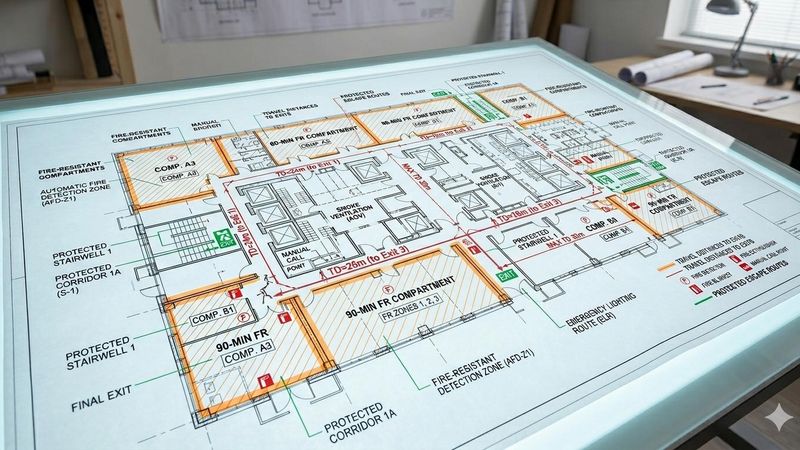
What is a Fire Strategy?
A fire strategy is a comprehensive technical document that outlines all fire safety measures for a building project. Unlike fire risk assessments which evaluate existing conditions, fire strategies are proactive planning documents essential for new construction, major refurbishments, and change of use projects.
Fire Strategy vs Fire Risk Assessment
| Fire Strategy | Fire Risk Assessment | |
|---|---|---|
| Purpose | Building design compliance | Operational safety evaluation |
| When | Design/construction phase | Operational buildings |
| Focus | Proactive planning | Current risk identification |
| Required for | Building Regulations approval | All non-domestic premises |
| Scope | Comprehensive building design | Existing conditions assessment |
| Outcome | Design documentation | Risk mitigation actions |
What’s Included in a Fire Strategy
A comprehensive fire strategy covers:
- Means of warning and escape — fire detection, alarm systems, escape route design, and evacuation strategy
- Internal fire spread — compartmentation, fire resisting construction, and fire stopping
- External fire spread — façade fire performance, boundary distances, and roof coverings
- Access and facilities for the fire service — fire engine access, water supplies, and firefighting lifts
- Smoke control systems — ventilation, pressurisation, and smoke extraction design
- Structural fire protection — fire resistance periods and structural steel protection
- Fire safety management procedures — ongoing management responsibilities and maintenance schedules
When You Need a Fire Strategy
- New build developments
- Major refurbishments and extensions
- Change of use applications
- Building regulation approvals
- Complex or high-rise buildings
- Higher-risk building gateway submissions
Fire Strategy Service Categories
Residential Development Fire Strategies — Specialised fire strategies for apartment blocks, student accommodation, and mixed-use developments including evacuation strategy planning, compartmentation design, smoke control systems, and resident safety management.
Commercial Building Fire Strategies — Comprehensive fire strategies for offices, retail, and commercial developments including occupancy load calculations, business continuity planning, fire service access optimisation, and active system integration.
Industrial Facility Fire Strategies — Specialised fire strategies for manufacturing, warehousing, and industrial facilities including hazardous material considerations, process-specific fire risks, emergency response planning, and asset protection strategies.
Healthcare & Education Fire Strategies — Expert fire strategies for hospitals, schools, and care facilities including vulnerable occupant provisions, phased evacuation planning, and medical equipment protection.
Get in touch to discuss your fire strategy requirements.
Who Needs a Fire Risk Assessment?
Fire strategies are mandatory for Building Regulations approval on new construction, major refurbishments, and change of use projects.
You Need a Fire Risk Assessment If You Have:
New build developments
Residential, commercial, and mixed-use new construction projects
Major refurbishments
Significant alterations, extensions, or change of use projects
Change of use
Converting buildings to a different use class
Residential developments
Apartment blocks, student accommodation, and care homes
Exemptions
Fire strategies are not required for single private dwellings or minor works that do not affect fire safety provisions. However, most building work that requires Building Regulations approval will need a fire strategy.
Our Fire Strategy Process
A structured 6-step approach to developing your fire strategy from initial consultation to project completion.
Initial Consultation & Project Assessment
Comprehensive project evaluation and requirements analysis. We review your plans, identify fire safety requirements, and assess the scope of work needed.
Design Integration & Collaborative Planning
Seamless integration with your design team. We work alongside architects and engineers to incorporate fire safety measures into the building design.
Technical Analysis & Fire Engineering
Comprehensive fire safety engineering review including means of escape, compartmentation, smoke control, and structural fire protection analysis.
Documentation & Report Preparation
Detailed fire strategy report creation covering all fire safety measures, specifications, and management procedures required for compliance.
Regulatory Submission & Building Control Liaison
Expert support through the approval process. We liaise directly with building control on your behalf to ensure smooth sign-off.
Construction Support & Ongoing Consultation
Continued guidance through project completion. We provide support during construction to ensure fire safety measures are implemented as designed.
Fire Strategy Costs UK 2026
Transparent pricing for fire strategy development. Costs vary based on project size, complexity, and building type.
Factors affecting cost: Costs are influenced by building size and height, design complexity, occupancy type, fire engineering requirements, and the level of building control liaison needed.
Fire Strategy Legislation & Standards 2026
The legal and regulatory framework governing fire strategy requirements in the UK.
Approved Document B (2019 edition)
The primary guidance document for fire safety in buildings. Covers means of warning and escape, internal and external fire spread, and access for the fire service.
Fire Safety Act 2021
Clarified that the Fire Safety Order applies to the structure, external walls, and flat entrance doors of multi-occupied residential buildings.
Building Safety Act 2022
Introduced the Building Safety Regulator, gateway points for high-risk buildings, and enhanced requirements for fire safety information throughout the building lifecycle.
Regulation 38 – Fire Safety Information
Requires fire safety information to be provided to building owners and occupiers. Fire strategies are the standard method for documenting this information.
BS 9999:2017 (amended 2024)
Code of practice for fire safety in the design, management and use of buildings. Provides a risk-based approach to fire safety design as an alternative to Approved Document B.
Higher-Risk Buildings Regime
Full implementation of the Building Safety Regime for higher-risk buildings, requiring gateway approvals at planning, pre-construction, and completion stages.
Residential PEEPs Regulations
Personal Emergency Evacuation Plans become mandatory for high-rise residential buildings, requiring fire strategies to incorporate person-centred evacuation provisions.
Frequently Asked Questions
Common questions about fire strategy services answered by our experts.
What is the difference between a fire strategy and a fire risk assessment?
When is a fire strategy legally required?
How long does fire strategy development take?
How much does a fire strategy cost?
Can you work with our existing design team?
What standards do fire strategies follow?
Ready to Get Your Fire Strategy?
Professional service from BAFE-accredited engineers. 24-hour turnaround. From £2,500 + VAT.