Fire Risk Assessment for
Care Homes
Professional fire risk assessments for care homes and residential care facilities. CQC compliant with PEEPs, medical oxygen safety, horizontal evacuation planning, and night staffing evaluation. BAFE SP205 registered assessors.
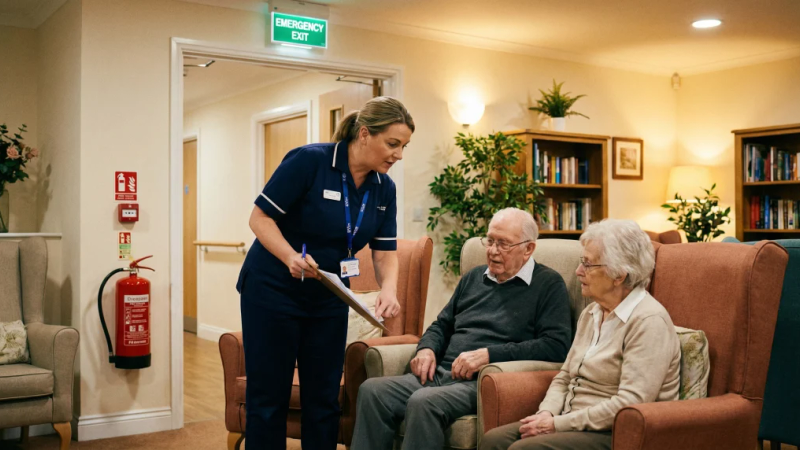
Care homes and residential care facilities require specialist fire risk assessments that account for vulnerable residents, progressive horizontal evacuation, medical oxygen safety, and CQC compliance requirements. Under the Regulatory Reform (Fire Safety) Order 2005 and CQC fundamental standards, care home operators must demonstrate that evacuation plans are tailored to each resident’s level of dependency.
Serving Care Homes Across the UK
We work with care home managers, registered managers, and compliance officers responsible for all types of care facilities:
- Residential care homes — elderly and vulnerable adult care
- Nursing homes — with medical gas and complex care needs
- Dementia specialist units — enhanced evacuation requirements
- Learning disability homes — tailored PEEP development
- Multi-home operators — coordinated compliance across locations
Complete CQC-Compliant Assessment Package
Every care home fire risk assessment includes a comprehensive package designed to meet all current legislative requirements and CQC inspection standards:
- Full home inspection — resident areas, communal spaces, kitchens, plant rooms
- Individual PEEP development — for each resident category and dependency level
- Fire compartmentation verification — 10-bed maximum per compartment compliance
- Medical oxygen safety assessment — storage, ventilation, and separation verification
- Horizontal evacuation planning — progressive routes and refuge area capacity
- Night staffing evaluation — adequacy against resident PEEPs and dependency categories
- Fire door inspection — FD30/FD60 ratings, self-closers, quarterly compliance
- Detailed photographic report — CQC-approved with risk ratings and prioritised action plan
- Ongoing compliance support — guidance on implementing recommendations and review scheduling
Why Care Home Managers Choose Fire Assessment North
Care home managers across the UK trust us for their facilities because we understand the specific challenges of vulnerable resident fire safety:
- 24-hour turnaround on standard assessments — CQC inspection ready
- BAFE SP205 registered — independently audited and accredited
- CQC-compliant documentation — accepted by inspectors without question
- PEEP specialists — individual plans for every resident category
- Medical oxygen expertise — storage, handling, and evacuation safety
- Portfolio discounts — reduced rates for multi-home operators
Why Care Home Fire Risk Assessments Are Non-Negotiable
CQC scrutiny has intensified. Only 58% of fire safety audits now pass inspection — the lowest rate since 2011.
588,855
Home fire safety visits conducted in 2024-2025
51,020
Fire safety audits with only 58% satisfactory
£14,556
Average enforcement fine for violations
The stakes have never been higher. Under the Regulatory Reform (Fire Safety) Order 2005 and CQC fundamental standards, every care home must maintain current, comprehensive fire risk assessments tailored to vulnerable residents. With 42% of audits failing and enforcement actions increasing 12% year-over-year, non-compliance risks fines up to £30,000, CQC rating downgrades, and potential licence revocation. Your residents' safety — and your facility's future — depend on getting this right.
Our Specialist Care Home Assessment Process
Comprehensive evaluations designed specifically for vulnerable resident environments and CQC inspection standards.
Site Inspection
Complete walk-through assessing fire compartmentation (10-bed compliance), horizontal evacuation routes, and resident care areas.
Vulnerable Resident Assessment
Evaluation of mobility limitations, cognitive impairments, dementia care needs, and PEEP requirements for each resident category.
Specialised Hazard Review
Medical oxygen storage safety, mobility equipment charging risks, resident cooking facilities, and smoking area compliance verification.
System & Equipment Testing
BS 5839-6 alarm compliance, L1 system coverage verification, self-closing fire door testing, and emergency lighting functionality.
CQC-Ready Report
Insurance-approved documentation with PEEP templates, night staffing recommendations, and prioritised action plan delivered in 24 hours.
6 Care Home-Specific Fire Hazards We Assess
These unique vulnerabilities require specialised knowledge that standard fire risk assessments miss.
Vulnerable Resident Evacuation (PEEPs)
Care home residents with mobility issues, dementia, cognitive impairment, or wheelchair dependence cannot self-evacuate within standard timeframes. Government guidance mandates fire compartment evacuation in two-and-a-half minutes, requiring specialised PEEPs for each vulnerable resident. Progressive horizontal evacuation strategies become essential for bedridden residents and those with advanced dementia who may resist evacuation.
Our Assessment:
Individual PEEP development for each resident category, night staffing adequacy evaluation against resident dependency levels, horizontal evacuation route capacity verification, and staff training recommendations for dementia-appropriate evacuation techniques. Fire compartmentation compliance ensures safe staged evacuation for residents requiring physical assistance.
Medical Oxygen Safety
Medical oxygen significantly increases fire risk through oxygen-enriched environments where materials ignite more readily and burn intensely. UK care homes using oxygen cylinders, piped oxygen systems, or bedside concentrators must implement strict safety protocols: upright secured storage in ventilated areas, 3-metre separation from ignition sources, and prohibition of smoking within oxygen zones.
Our Assessment:
Oxygen storage location safety evaluation, ventilation adequacy verification, 'No Smoking' signage compliance inspection, separation distance measurements from electrical equipment and heat sources, concentrator electrical safety assessment, staff handling procedure review, and resident PEEP integration accounting for oxygen-dependent evacuation complexities.
Resident Kitchen Facilities
Care homes face elevated kitchen fire risks from residents cooking independently in room kitchenettes or participating in assisted cooking activities. Residents with cognitive impairment may leave cooking unattended, those with mobility limitations cannot respond quickly to emergencies, and varying capability levels require individualised risk assessments.
Our Assessment:
Kitchen layout safety evaluation for both communal and individual kitchenette facilities, heat detector placement verification (non-smoke detectors preventing false alarms), resident cooking capability assessment integrated into PEEPs, supervision protocol review for assisted cooking activities, and appliance safety feature evaluation.
Mobility Equipment Charging
Electric wheelchairs, mobility scooters, profiling beds, and patient hoists require regular charging, often overnight in resident rooms or corridors. Lithium-ion batteries in modern mobility equipment present thermal runaway risks, older equipment may have degraded wiring, and charging in bedrooms during sleeping hours presents evacuation complications.
Our Assessment:
Designated charging area safety evaluation with adequate ventilation and fire separation, electrical circuit capacity verification for simultaneous charging loads, charging practice review (overnight bedroom charging vs supervised charging stations), equipment age and maintenance record evaluation, and resident PEEP considerations for equipment-dependent mobility.
Smoking Areas & Fire Risk
Smoking materials remain significant fire ignition sources in care settings, particularly for residents with cognitive impairment who may smoke unsupervised, mobility limitations preventing quick response to dropped cigarettes, or residents on supplemental oxygen creating extreme fire hazards. Designated outdoor smoking areas must balance resident independence with safety supervision.
Our Assessment:
Smoking policy documentation review including individual resident risk assessments, designated outdoor smoking area safety evaluation (distance from building openings, oxygen storage locations, combustible materials), supervision protocol adequacy verification, cigarette disposal receptacle inspection, and staff training assessment on smoking-related fire prevention.
Night Staffing & Alarm Systems
Reduced night staffing levels present significant fire safety challenges when most residents are sleeping and least able to self-evacuate. UK regulations mandate risk-based staffing determined by resident PEEPs. At least one trained fire marshal must be on duty throughout night shifts, with adequate staffing to simultaneously implement all resident PEEPs within two-and-a-half minute evacuation timeframes.
Our Assessment:
Night staffing level adequacy evaluation against total resident PEEPs and dependency categories, fire marshal presence verification throughout all shifts including nights, waking staff vs sleeping-in staff configuration assessment, emergency response protocol review, evacuation drill evaluation including nighttime scenarios, and documentation review demonstrating risk-based staffing justification.
How Much Does a Care Home Fire Risk Assessment Cost?
Costs typically range from £495–£2,000 depending on home size, number of residents, and complexity of care needs.
Factors affecting cost: Costs are influenced by number of beds, number of floors, resident dependency levels, presence of medical oxygen, dementia care requirements, and CQC inspection urgency. Multi-home portfolios benefit from 10-15% bulk discount.
Frequently Asked Questions
Common questions from care home managers, registered managers, and compliance officers about fire safety.
What are PEEPs and do we need them for care home residents?
What are CQC fire safety requirements for care homes?
How do we evacuate residents with dementia during a fire?
Is medical oxygen a fire risk in care homes?
How many staff need fire safety training in a care home?
Do we need horizontal evacuation in care homes?
How often should care homes review fire risk assessments?
What night staffing levels do we need for fire safety?
Ready to Get Your Fire Risk Assessment for Care Homes?
Professional service from BAFE-accredited engineers. 24-hour turnaround. From £495 + VAT.