Emergency Light Testing
BS 5266 Compliance Testing
Professional emergency lighting testing by BAFE registered engineers in accordance with BS 5266-1. Full 3-hour duration discharge testing included as standard.
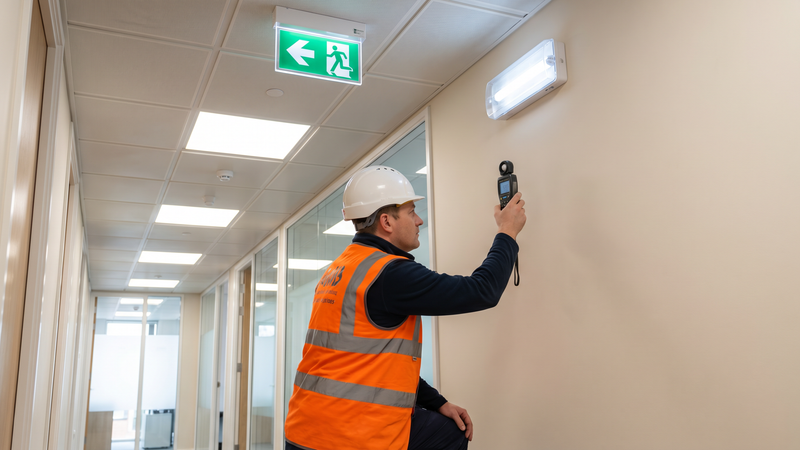
What is Emergency Light Testing?
Emergency light testing checks that your emergency lighting activates when the mains power fails and keeps escape routes lit long enough for everyone to get out. When a fire knocks out the power, emergency lighting is the only thing standing between your occupants and total darkness.
All emergency lighting in UK non-domestic premises must meet BS 5266-1:2016, the British Standard for emergency lighting. The Regulatory Reform (Fire Safety) Order 2005 makes it a legal duty for the responsible person to keep these systems maintained and tested.
What Our Emergency Light Testing Includes
- Functional test of every luminaire and illuminated exit sign
- Battery condition check on all self-contained units
- Full-duration discharge test (annual visits — 3 hours or 1 hour as applicable)
- Lamp and LED condition inspection — light output and lens clarity
- Charging system verification — confirming units recharge correctly after testing
- Central battery system checks where fitted — charger output and cell condition
- Log book completion on-site with full test records
- Compliance certificate issued on completion, accepted by fire authorities and insurers
Faults found during testing are documented with clear recommendations. We carry common replacement batteries and lamps on every van, so most repairs are done in the same visit.
Emergency Lighting Test Schedule
| Frequency | Test Type | Duration | Who Should Do It |
|---|---|---|---|
| Monthly | Functional flash test | 30 seconds | Trained on-site staff |
| Quarterly | Visual inspection | N/A | Trained on-site staff |
| Annually | Full-duration discharge | 3 hours (or 1hr) | Qualified engineer |
Types of Emergency Lighting
- Maintained — Run continuously during normal operation and switch to battery power when mains fails. Common above final exits and in theatres and cinemas.
- Non-maintained — Only activate when the mains supply drops out. The most common type in offices and commercial buildings. Because they are not lit day-to-day, monthly testing is essential.
- Sustained — Dual-function fittings with a standard lamp on mains and an emergency lamp on battery backup.
Self-contained vs Central Battery Systems
Self-contained units have individual batteries built into each luminaire. Cheaper to install but each unit must be tested individually. Central battery systems run all emergency lights from a single battery bank, usually in a plant room. Easier to maintain in large buildings but more complex to test.
Who Needs a Fire Risk Assessment?
Under the Regulatory Reform (Fire Safety) Order 2005, the responsible person for any non-domestic premises must ensure emergency lighting systems are maintained and tested.
You Need a Fire Risk Assessment If You Have:
Commercial premises
Offices, shops, warehouses, restaurants, and all non-domestic buildings
Residential buildings
Blocks of flats (communal areas), HMOs, care homes, and student accommodation
Healthcare premises
Hospitals, GP surgeries, dental practices, and care facilities
Public buildings
Community centres, libraries, churches, and sports facilities
Exemptions
Single private dwellings (houses) are exempt from emergency lighting testing requirements. However, Houses in Multiple Occupation (HMOs), blocks of flats, and all non-domestic premises must have emergency lighting tested and maintained to BS 5266-1.
Our Emergency Light Testing Process
A structured 5-step approach to emergency lighting testing, from booking to BS 5266 compliance certification.
Book Your Test
Call us or fill in the form. We schedule around your operations to minimise disruption.
Engineer Arrives
A BAFE registered engineer arrives with all necessary testing equipment and spare parts.
System Tested
Every luminaire, exit sign, and battery is tested to BS 5266-1:2016 standards.
Report Delivered
Detailed report with any faults found, battery condition, and recommendations within 24 hours.
Certificate Issued
BS 5266 compliance certificate issued and log book completed on-site.
Emergency Light Testing Costs UK 2026
What you pay depends on the number of luminaires and the complexity of the building.
Factors affecting cost: Annual maintenance contracts that bundle monthly spot-checks and the annual full-duration test save 15-20% compared to one-off bookings. Common replacement batteries and lamps are carried on every van, so most repairs are done in the same visit.
Emergency Lighting Legislation & Standards 2026
The legal and regulatory framework governing emergency lighting testing in the UK.
Regulatory Reform (Fire Safety) Order 2005
Requires the responsible person to ensure emergency lighting systems are maintained in good working order. The foundation of UK fire safety law for non-domestic premises.
BS 5266-1:2016
The British Standard covering emergency lighting of premises. Specifies requirements for design, installation, wiring, servicing, and testing of emergency lighting systems.
Fire Safety Act 2021
Clarified that the Fire Safety Order applies to the structure and fire safety systems of multi-occupied residential buildings, including emergency lighting.
Fire Safety (England) Regulations 2022
Introduced additional requirements for fire safety information sharing in high-rise buildings, including emergency lighting system documentation.
Building Safety Act 2022
Enhanced requirements for fire safety documentation and system maintenance in higher-risk buildings under the Building Safety Regime.
Residential PEEPs Regulations
Personal Emergency Evacuation Plans become mandatory for high-rise residential buildings, requiring emergency lighting on escape routes to be verified as fully operational.
Frequently Asked Questions
Common questions about emergency light testing answered by our experts.
How often should emergency lighting be tested?
What is a full-duration emergency lighting test?
What is BS 5266 emergency lighting?
Who is responsible for emergency lighting testing?
How long should emergency lights stay on?
Do emergency lights need annual certification?
Ready to Get Your Emergency Light Testing?
Professional service from BAFE-accredited engineers. 24-hour turnaround. From £70.