Type something to search...
The April 2026 Deadline: Preparing Your Portfolio for Mandatory Residential Evacuation Plans
  • By Fire Assessment North/ On 11 May, 2026

The April 2026 Deadline: Preparing Your Portfolio for Mandatory Residential Evacuation Plans

In 2026, residential building owners across England face the most significant fire safety regulatory change since the Grenfell Tower Inquiry. The Fire Safety (Residential Evacuation Plans) (England) Regulations 2025 come into force on 6 April 2026, mandating Personal Emergency Evacuation Plans (PEEPs) for approximately 12,500 high-rise buildings nationwide (Tetra Consulting, 2026).

The stakes are high. Fire safety prosecutions in England rose 79% in 2023/24, with £1.4 million in fines issued for non-compliance (Fire Marshal Training, 2025). With only months until the deadline, property managers, freeholders, and Responsible Persons need to act now.

Key Takeaways

Which Buildings Are Affected by the April 2026 Deadline?

The Fire Safety (Residential Evacuation Plans) (England) Regulations 2025 apply to residential buildings in England that meet specific height thresholds (Kent Fire & Rescue, 2026). As of January 2026, approximately 12,500 buildings in England are 18 metres or taller, with an estimated 65,000 buildings exceeding 11 metres (Tetra Consulting, 2026).

Buildings covered by the new regulations:

  • High-rise residential buildings: 18 metres or 7 storeys above ground level
  • Medium-rise residential buildings: 11 metres or height specified in future regulations
  • Buildings with sleeping accommodation (care homes, student housing)
  • Mixed-use buildings with residential units

The regulations require Responsible Persons to identify residents who may struggle to self-evacuate and develop person-centred fire risk assessments (PCFRAs) for each vulnerable individual (Cheshire Fire, 2026).

According to the government’s impact assessment, disabled residents are disproportionately affected by fire incidents. At Grenfell Tower, 40% of those who died were disabled people, despite comprising approximately 13% of the population (Fire Protection Association, 2025). These regulations directly address that disparity.
Emergency exit sign on building

What Are Residential Personal Emergency Evacuation Plans (PEEPs)?

Residential PEEPs are individualised evacuation plans for residents who may need assistance to escape a fire safely. Unlike generic fire procedures, PEEPs are tailored to each person’s specific needs, considering mobility limitations, sensory impairments, cognitive conditions, and temporary factors like pregnancy or recovery from surgery (GOV.UK, 2025).

The new regulations introduce two key documents:

Residential Personal Emergency Evacuation Plans (RPEEPs): Detailed plans for individual residents, developed through person-centred consultations. These must include the resident’s specific needs, required assistance, evacuation routes, and any equipment needed (such as evacuation chairs or communication aids).

Person-Centred Fire Risk Assessments (PCFRAs): Systematic assessments that evaluate each resident’s ability to evacuate independently. PCFRAs identify reasonable and proportionate mitigation measures, balancing safety improvements with practical feasibility (Cheshire Fire, 2026).

About 10% of the UK population has a mobility impairment, and 7.5% experience stamina or breathing difficulties (GOV.UK, 2025). In multi-storey residential buildings, these residents face disproportionate risk during evacuations.

Unique Insight

The compliance challenge isn’t just identifying vulnerable residents—it’s the “moving target” problem. Student accommodation sees annual turnover, general needs housing sees regular tenancy changes, and ageing residents develop new mobility issues over time. Smart property managers are building PEEP processes into their standard tenancy onboarding and annual review cycles, treating evacuation planning as ongoing operational practice, not a one-time compliance project.

England Residential Buildings by Height (2026)18m+ (High-Rise): 12,500 buildings11-18m (Mid-Rise): 52,500 buildingsUnder 11m: Not affectedTotal affected buildings: ~65,000PEEPs mandatory for 18m+ from April 2026

Source: Tetra Consulting Analysis 2026, GOV.UK Building Safety Data

According to the regulations, PEEPs must be proportionate to the level of risk and the resident’s needs. Not every mitigation measure requires expensive equipment—many solutions involve procedural changes, communication improvements, or staff training (GOV.UK, 2025).

From 6 April 2026, Responsible Persons must fulfil several specific legal duties under the Fire Safety (Residential Evacuation Plans) (England) Regulations 2025 (GOV.UK, 2025). Failure to comply can result in unlimited fines or up to two years in custody for serious breaches (Sheffield NHS, 2025).

Core legal duties include:

  1. Identify relevant residents: Proactively identify all residents who may need support to evacuate, including those with mobility impairments, sensory disabilities, cognitive conditions, or temporary limitations.

  2. Complete Person-Centred Fire Risk Assessments (PCFRAs): Conduct individual assessments for each relevant resident, evaluating their specific evacuation needs and the building’s features that affect escape routes.

  3. Develop Residential PEEPs: Create personalised evacuation plans that specify how each resident will be assisted, who will provide assistance, what equipment is needed, and what procedures will be followed.

  4. Provide information to Fire and Rescue Services: Share building-level evacuation information with local fire services, including floor plans, locations of vulnerable residents, and details of evacuation equipment.

  5. Inform residents and staff: Ensure all residents are aware of the evacuation procedures, and staff members receive appropriate training on PEEP implementation.

The Responsible Person is typically the building owner, freeholder, or managing agent. In buildings with multiple Responsible Persons (such as mixed tenure blocks), duties are shared, and cooperation is required (Bedfordshire Fire, 2026).

Fire and Rescue Services completed 51,020 fire safety audits in England in the year ending March 2025, with 42% resulting in unsatisfactory outcomes (GOV.UK, 2025). With heightened focus on residential evacuation planning, enforcement activity is expected to increase significantly after April 2026.

Fire escape stairs on residential building

Understand your full fire safety legal obligations

How to Implement PEEPs Before the April 2026 Deadline

Implementing Residential PEEPs requires systematic planning and execution. Following this step-by-step approach will help ensure compliance before the April 2026 deadline.

Step 1: Conduct a Building-Wide Risk Assessment

Before identifying individual residents, assess your building’s evacuation infrastructure. Review escape routes, fire detection systems, firefighting equipment, and building features that affect evacuation (GOV.UK, 2025).

Key assessment elements:

  • Floor plans showing primary and secondary escape routes
  • Location of fire doors, stairwells, and evacuation equipment
  • Fire alarm system coverage and capability
  • Existing evacuation procedures and signage
  • Building construction and fire-rated compartments

This baseline assessment provides the foundation for individual PEEPs and helps identify building-level improvements that may be needed.

Step 2: Identify and Engage with Residents

Proactively identify residents who may need evacuation assistance. This includes visible disabilities (wheelchair users, mobility impairments) and non-visible conditions (hearing or visual impairments, cognitive conditions, heart conditions, respiratory issues).

36% of UK households include at least one member with a disability, rising from 34% in 2019-20 (Parliamentary Committee, 2024). Don’t rely on self-disclosure alone—use tenancy records, regular communication, and respectful direct engagement.

Engagement best practices:

  • Send personalised communications explaining the new requirements
  • Offer private consultation options (in-home, video, telephone)
  • Emphasise that PEEPs improve safety for all residents
  • Ensure confidentiality and dignity throughout the process

Step 3: Complete Person-Centred Fire Risk Assessments

For each relevant resident, complete a PCFRA that evaluates their specific needs. The assessment should consider (Cheshire Fire, 2026):

  • Mobility: Can they use stairs independently? Do they use mobility aids?
  • Sensory: Can they hear fire alarms? Can they see emergency signage?
  • Cognitive: Can they understand and follow evacuation procedures independently?
  • Temporary factors: Surgery, pregnancy, injury, or medication side effects
  • Assistance network: Family, carers, or neighbours who can help

The assessment must be “person-centred”—engaging directly with the resident about their needs rather than making assumptions based on medical categories.

Step 4: Develop Individual PEEPs

Create a written PEEP for each relevant resident. The plan should specify (GOV.UK, 2025):

  • The resident’s evacuation route from their flat to the assembly point
  • What assistance they need and who will provide it
  • Any equipment required (evacuation chair, communication aids, etc.)
  • Alternative procedures if primary routes are blocked
  • How the resident will be alerted to a fire
  • Staff responsibilities and training requirements

PEEPs must be “reasonable and proportionate”—not every measure is practical or necessary. Focus on solutions that deliver meaningful safety improvements within realistic constraints.

Step 5: Implement Building-Level Improvements

Individual PEEPs may reveal building-level improvements needed. Common enhancements include (GOV.UK, 2025):

  • Installing evacuation chairs or lifts on key floors
  • Enhancing fire alarm systems (visual alerts, tactile devices)
  • Improving escape route signage and lighting
  • Upgrading fire doors to relevant compartments
  • Providing two-way communication systems

Costs for “mitigating measures” can only be charged to all residents through service charges if the measures benefit most residents—not just the individual (GOV.UK, 2026). Building-wide improvements typically qualify, while individual equipment usually remains the Responsible Person’s responsibility.

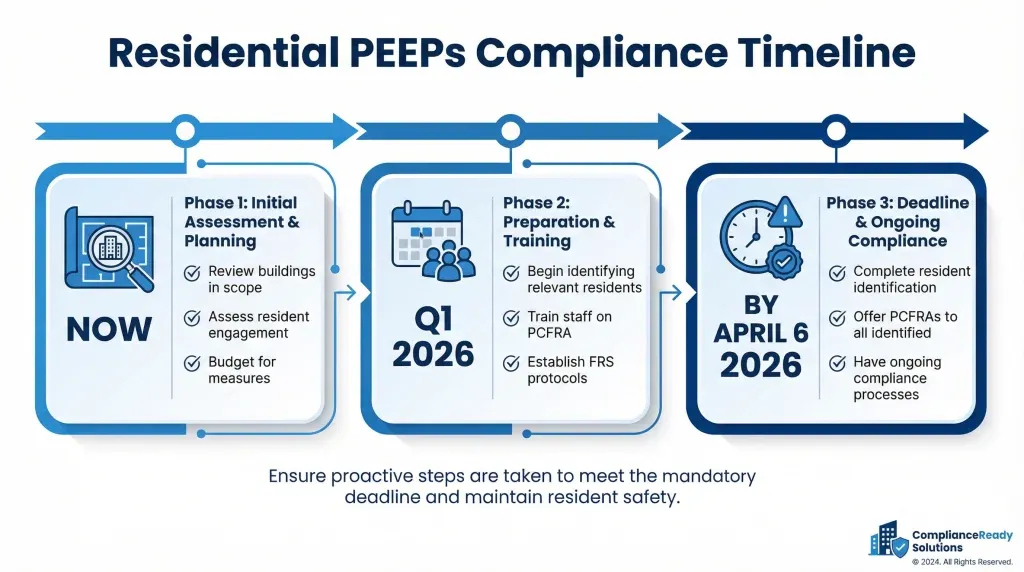
PEEP Implementation Timeline (Pre-Deadline)Phase 1Nov–Dec 2025Building assessmentPhase 2Jan 2026Identify residentsPhase 3Feb 2026Complete PCFRAsPhase 4Mar 2026Write PEEPsPhase 5Late Mar 2026Install equipmentPhase 6Early Apr 2026Staff training6 April 2026 — DEADLINE: All PEEPs in place

Source: Fire Assessment North Implementation Guide 2026

Step 6: Train Staff and Share Information

Ensure all relevant staff understand PEEPs and their roles in implementation. Training should cover (London Fire Brigade, 2025):

  • Identifying and assisting vulnerable residents during evacuations
  • Operating evacuation equipment safely
  • Communicating with residents who have sensory or cognitive impairments
  • Updating PEEPs when resident circumstances change

Share evacuation information with your local Fire and Rescue Service, including floor plans, locations of vulnerable residents, and details of evacuation equipment. This information helps firefighters respond more effectively in emergencies.

Step 7: Establish Ongoing Review Processes

PEEPs aren’t one-time documents. They must be reviewed and updated when:

  • A new resident moves in with evacuation needs
  • An existing resident’s needs change
  • Building modifications affect escape routes
  • Annual fire safety reviews are conducted

Build PEEP reviews into your regular fire safety management processes to ensure ongoing compliance.

What Are the Costs and Funding Options?

Implementing PEEPs involves costs for assessment, planning, equipment, and training. While exact figures vary by building size and resident needs, understanding typical costs helps with budgeting (Tetra Consulting, 2026).

Typical cost categories:

Cost CategoryTypical RangeNotes
Fire Risk Assessment (with PEEP focus)£400-£1,200Depends on building size and complexity
Individual PCFRAs£50-£150 per assessmentVaries by resident complexity
Evacuation Chairs£600-£1,500 eachOne per 3-5 floors typically needed
Visual Alarm Devices£150-£400 eachFor residents with hearing impairments
Staff Training£500-£2,000 per sessionDepends on staff numbers and content
Ongoing Review£200-£800 annuallyAnnual PEEP review and updates

According to government guidance, costs for PEEP implementation can only be recovered through service charges if the measures benefit most residents in the building (GOV.UK, 2025). Individual measures typically remain the Responsible Person’s responsibility.

For social housing providers, government funding may be available for building safety improvements. Private sector landlords should factor PEEP costs into their operational budgets and consider them part of their legal fire safety obligations.

The cost of non-compliance far exceeds implementation costs. With fire safety prosecutions up 79% and £1.4 million in fines issued in 2023/24 (Fire Marshal Training, 2025), investing in compliance now avoids significant financial and reputational risk later.

What Happens If You Don’t Comply by the Deadline?

Non-compliance with the Fire Safety (Residential Evacuation Plans) (England) Regulations 2025 carries serious consequences (London Fire Brigade, 2025).

Enforcement consequences:

  1. Enforcement Notices: Fire and Rescue Services can issue notices requiring compliance within specified timeframes. Failure to comply leads to further enforcement action.

  2. Alteration Notices: For serious breaches, FRS can prohibit specific activities or require building modifications until safety concerns are addressed.

  3. Prosecution: Responsible Persons can be prosecuted for regulatory breaches. Convictions can result in unlimited fines or up to two years’ custody for the most serious offences.

  4. Reputational Damage: Non-compliance becomes public record, affecting tenant relationships, property values, and professional standing.

  5. Civil Liability: If a fire causes harm that could have been prevented by proper PEEPs, civil liability claims may follow.

With 42% of fire safety audits in England resulting in unsatisfactory outcomes in 2024/25 (GOV.UK, 2025), FRS activity is expected to increase significantly after April 2026. The Grenfell Tower Inquiry’s recommendations have intensified scrutiny on residential fire safety—non-compliance won’t go unnoticed.

From Our Experience

Working with property managers across the North West, we’ve seen a clear pattern: those who started PEEP planning in early 2025 are now completing implementation with minimal disruption. Those who waited are facing inflated contractor costs, equipment shortages, and compressed timelines. The “wait for clarification” approach proved costly—the guidance was published in July 2025, and early adopters gained significant advantages.

Frequently Asked Questions

Do the new PEEP regulations apply to all residential buildings?

No. The Fire Safety (Residential Evacuation Plans) (England) Regulations 2025 apply to residential buildings in England that are 18 metres or 7 storeys above ground level (Kent Fire & Rescue, 2026). Medium-rise buildings (11-18 metres) will be affected by future regulations, but the April 2026 deadline specifically targets high-rise residential buildings. Approximately 12,500 buildings in England fall into this category (Tetra Consulting, 2026).

Who is the “Responsible Person” under the new regulations?

The Responsible Person is typically the building owner, freeholder, or managing agent who has control over the premises (GOV.UK, 2005). In mixed-tenure buildings (some leasehold, some social housing), there may be multiple Responsible Persons who share duties and must cooperate on PEEP implementation (Bedfordshire Fire, 2026). If you’re unsure whether you’re the Responsible Person, check your building insurance, management contracts, or seek legal advice.

What happens if a resident refuses to engage with the PEEP process?

Responsible Persons must make reasonable efforts to identify and engage with residents who may need evacuation assistance (GOV.UK, 2025). Document all engagement attempts and communication. If a resident refuses to participate, record this decision and the steps taken. However, you still have a duty to consider their potential needs based on observable information and make reasonable provisions. The regulations emphasise “reasonable and proportionate” measures—you cannot force participation but must demonstrate diligent effort.

Can I charge residents for PEEP implementation costs?

Costs can only be recovered through service charges if the measures benefit most residents in the building (GOV.UK, 2026). Building-wide improvements (enhanced alarms, upgraded fire doors, evacuation chairs serving multiple residents) typically qualify. Individual measures specific to one resident (personal evacuation chair, home modifications) usually remain the Responsible Person’s responsibility. Consult the government’s guidance on cost apportionment and seek advice if uncertain about specific expenses.

How often do PEEPs need to be reviewed?

PEEPs should be reviewed whenever a resident’s circumstances change, when building modifications affect evacuation routes, or as part of annual fire safety reviews (GOV.UK, 2025). Best practice is to build PEEP reviews into regular tenancy management processes—onboarding new residents, annual check-ins, and responding to reported changes in health or mobility. This proactive approach ensures PEEPs remain current and effective.

Will Fire and Rescue Services check PEEPs during inspections?

Yes. From April 2026 onwards, Fire and Rescue Service audits will include checks for Residential PEEP compliance (GOV.UK, 2025). Inspectors will expect to see evidence of resident identification, completed PCFRAs, written PEEPs, staff training records, and information sharing with the FRS. With enforcement action rising (42% of audits resulted in unsatisfactory outcomes in 2024/25), thorough documentation is essential for demonstrating compliance.

Conclusion: Time Is Running Out

The April 2026 deadline for Residential PEEPs is approaching fast. With approximately 12,500 affected buildings in England and fire safety enforcement intensifying, property managers and Responsible Persons must act now (Tetra Consulting, 2026).

Key actions before April 2026:

  • Complete building-wide evacuation risk assessments
  • Identify all residents who may need evacuation assistance
  • Conduct Person-Centred Fire Risk Assessments (PCFRAs)
  • Develop written Residential PEEPs for vulnerable residents
  • Implement necessary equipment and building improvements
  • Train staff on PEEP implementation and resident assistance
  • Share evacuation information with local Fire and Rescue Services

The human cost of getting this wrong is too high. At Grenfell Tower, 40% of those who died were disabled residents who lacked evacuation plans (Fire Protection Association, 2025). These regulations exist to prevent that tragedy from repeating.

Need help preparing your residential portfolio for the April 2026 deadline? Contact us for professional PEEP implementation support.


Sources:

  • Tetra Consulting, Residential PEEPs Explained, retrieved 2026-05-11
  • Fire Marshal Training, Fire Safety Prosecution Statistics UK 2026, retrieved 2026-05-11
  • GOV.UK, Residential PEEPs Guidance for Responsible Persons, retrieved 2026-05-11
  • GOV.UK, Fire Prevention and Protection Statistics England April 2024 to March 2025, retrieved 2026-05-11
  • Parliamentary Committee, Disabled People in the Housing Sector Report 2024, retrieved 2026-05-11
  • London Fire Brigade, Fire Safety Law Explained, retrieved 2026-05-11
  • Cheshire Fire, Fire Safety Residential Evacuation Plans Regulations 2025, retrieved 2026-05-11

Tags:

  • Residential PEEPs
  • Fire safety regulations
  • Evacuation plans
  • April 2026 deadline
  • Fire risk assessment
  • High rise buildings

Share:

Categories

  • Fire safety (4)
  • Residential property (1)
  • Compliance (1)
  • Commercial property (1)
  • Green energy (1)
  • Hmo compliance (1)
  • Landlord guides (1)
  • Vacant property (1)
  • Industrial security (1)

Tags

  • Residential peeps
  • Fire safety regulations
  • Evacuation plans
  • April 2026 deadline
  • Fire risk assessment
  • High rise buildings
  • Lithium ion battery safety
  • Solar panel fire risk
  • Ev charging
  • Commercial fire safety
  • Green energy
  • Hmo fire safety
  • Landlord compliance
  • Student accommodation
  • Leeds
  • Liverpool
  • Vacant property security
  • Arson prevention
  • Industrial fire safety
  • Warehouse security
  • Fire suppression
  • Vacant building protection

Related Posts

Fire Safety
blog-thumb
By Fire Assessment North/ On 11 May, 2026

The Green Energy Transition: Managing Lithium-Ion and Solar Panel Fire Risks in Commercial Sites

In 2026, commercial property owners face a new fire safety challenge that didn't exist a decade ago. The green energy transition brings lithium-ion batteries, solar panels, and EV charging stations to commercial sites — and with them, fire risks that traditional safety assessments often miss. In 2026, 54% of UK businesses reported experiencing lithium-ion battery incidents, with one in five suffering fires or explosions (Aviva, 2025). Solar panel fires increased by approximately 60% over the two years to 2025 (QBE Insurance, 2025). These aren't isolated incidents — they're a systemic shift in commercial fire risk profiles. The Regulatory Reform (Fire Safety) Order 2005 requires property owners to assess and mitigate all significant fire risks. Green energy technologies are now firmly on that list. This guide explains what commercial property owners, facility managers, and landlords need to know.Key Takeaways54% of UK businesses experienced lithium-ion battery incidents in 2025 (Aviva, 2025) Solar panel fires increased 60% between 2023-2025 (QBE Insurance, 2025) Lithium-ion thermal runaway can reach 600-1,063°C, exceeding traditional fire ratings (ScienceDirect, 2025) Fire risk assessments for green energy systems cost £200-£1,400 for commercial premisesAre Lithium-Ion Batteries a Fire Risk for Commercial Properties? In 2026, 54% of UK businesses reported lithium-ion battery incidents, with 19% experiencing fires or explosions (Aviva, 2025). These aren't theoretical risks — they're happening now in warehouses, offices, retail spaces, and car parks across the country. The danger lies in thermal runaway — a chain reaction where damaged or overheating lithium-ion cells generate heat that triggers neighbouring cells to fail, creating temperatures of 600-1,063°C in seconds (Sandia National Labs, ScienceDirect, 2025). Traditional building materials and fire-rated compartments aren't designed for such intense, sustained heat. Commercial properties face specific lithium-ion risks across several areas: Battery Energy Storage Systems (BESS): Site-wide battery installations store renewable energy but create concentrated fire loads. A 2025 study found that BESS incidents account for 28% of all commercial energy-related fires (UL Solutions, 2025). EV Charging in Car Parks: The UK Parliament halted EV charging in its own covered car parks during 2025 while assessing fire-risk profiles (Clear Insurance Management, 2025). The concern isn't just the vehicles — it's the charging infrastructure, battery degradation over time, and the difficulty of extinguishing burning batteries in enclosed spaces. Forklift and Mobility Fleets: Commercial premises with electric forklifts, scooters, or bikes face charging risks. The Phoenix Fire Department investigated five lithium-ion fires in January 2026 alone, with micro-mobility devices comprising the highest category (Phoenix Fire Department, 2026). According to the NIST multi-source data analysis, there have been an estimated 5,718 lithium-ion battery fires (95% CI: 2,866–8,570) across all sectors, with commercial properties disproportionately represented in severity (NIST, 2025). The exponential growth of lithium-ion incidents tracks directly with EV adoption curves. Commercial properties that installed EV charging in 2020-2022 are now entering the "danger zone" — battery degradation patterns suggest that 3-5 year old charging systems represent the peak risk window for thermal runaway events. We expect incident rates to climb through 2027 before plateauing as first-generation installations reach end-of-life.<RawHTML html={` <svg viewBox="0 0 560 380" xmlns="http://www.w3.org/2000/svg" style="max-width: 100%; height: auto;"<text x="280" y="40" text-anchor="middle" fill="#ffffff" font-size="22" font-weight="bold" > Commercial Lithium-Ion Incident Types (UK 2025) </text> <g transform="translate(60, 80)"> <rect x="0" y="0" width="440" height="50" fill="#ef4444" rx="4" /> <text x="220" y="32" text-anchor="middle" fill="#ffffff" font-size="16" font-weight="600" > EV Charging Infrastructure: 35% </text> <rect x="0" y="70" width="352" height="50" fill="#f97316" rx="4" /> <text x="176" y="102" text-anchor="middle" fill="#ffffff" font-size="16" font-weight="600" > Battery Storage (BESS): 28% </text> <rect x="0" y="140" width="264" height="50" fill="#eab308" rx="4" /> <text x="132" y="172" text-anchor="middle" fill="#ffffff" font-size="16" font-weight="600" > Forklift/Mobility: 22% </text> <rect x="0" y="210" width="176" height="50" fill="#22c55e" rx="4" /> <text x="88" y="242" text-anchor="middle" fill="#ffffff" font-size="16" font-weight="600" > Devices/Other: 15% </text> </g> Source: UL Solutions Lithium-Ion Incident Reporting 2025, Aviva Business Survey 2025`} />Do Solar Panels Increase Fire Risk on Commercial Buildings? In 2025, global business insurer QBE revealed that UK fire services faced a 60% increase in fires involving solar panels over the previous two years (Fletcher Risk, 2026). This isn't because solar panels themselves are inherently dangerous — it's because solar installations create new fire pathways that traditional assessments miss. The fundamental issue is PV fault inevitability. According to the European Solar Fire Safety Summit 2025, PV faults are unavoidable over a 25-30 year system lifespan: connectors degrade, hotspots develop, cables suffer damage, and installation errors surface years later (AllShield Coatings, 2025). When PV faults occur, the risk isn't the panels themselves — it's what's beneath them. Solar installations create voids between panels and roof surfaces, allowing flames to spread horizontally in ways that traditional roof construction never anticipated. The Southwest Research Institute conducted large-scale tests in 2025 confirming that solar panels can accelerate flame spread beneath installations, particularly on combustible roof materials (SwRI, 2026). Commercial properties face specific solar fire risks: Bitumen Roofs: Many commercial flat roofs use bitumen or torch-on membranes — highly combustible materials that PV panels can shield from fire suppression systems while creating chimney effects for flame spread. Ballasted Installations: Solar panels held in place by concrete blocks can hinder firefighter access and complicate roof operations during fires. DC Arc Faults: High-voltage DC wiring from panels to inverters can generate arc faults that ignite surrounding materials, particularly where cables penetrate roof structures. The NFPA Fire Protection Research Foundation presented updated findings in September 2025, emphasizing that PV panels on building roofs require specific hazard assessment and mitigation solutions that go beyond standard electrical codes (NFPA FPRF, 2025). <RawHTML html={` <svg viewBox="0 0 560 380" xmlns="http://www.w3.org/2000/svg" style="max-width: 100%; height: auto;"<text x="280" y="40" text-anchor="middle" fill="#ffffff" font-size="22" font-weight="bold" > UK Solar Panel Fire Incidents (2020-2025) </text> <g transform="translate(60, 70)"> <text x="0" y="0" fill="#e2e8f0" font-size="14"> 2020: 45 incidents </text> <rect x="0" y="15" width="45" height="20" fill="#3b82f6" rx="2" /> <text x="0" y="65" fill="#e2e8f0" font-size="14"> 2022: 68 incidents </text> <rect x="0" y="80" width="68" height="20" fill="#3b82f6" rx="2" /> <text x="0" y="130" fill="#e2e8f0" font-size="14"> 2024: 98 incidents </text> <rect x="0" y="145" width="98" height="20" fill="#3b82f6" rx="2" /> <text x="0" y="195" fill="#e2e8f0" font-size="14"> 2025: 117 incidents (estimated) </text> <rect x="0" y="210" width="117" height="20" fill="#ef4444" rx="2" /> <text x="60" y="270" fill="#f97316" font-size="16" font-weight="600"> +160% increase from 2020 </text> </g> Source: QBE Insurance UK Fire Statistics 2025, PV Fire Intelligence Network`} />According to the Southwest Research Institute, flame spread beneath solar installations can be 2-3 times faster than on exposed roof surfaces, particularly where panels create channels that direct fire toward roof penetrations and ventilation points (SwRI, 2025). Get your solar fire risk assessed How Do EV Charging Stations Change Fire Risk Profiles? In 2025, the UK Parliament made a striking decision: it halted EV charging in its own covered car parks while assessing fire-risk profiles (Clear Insurance Management, 2025). This move sent a clear signal to commercial property owners — EV charging isn't plug-and-play from a fire safety perspective. The challenges are threefold: Thermal Runaway in Enclosed Spaces: Lithium-ion battery fires in enclosed car parks behave fundamentally differently from traditional vehicle fires. They generate temperatures exceeding 1,000°C, produce toxic gases, and can reignite hours after initial suppression. The Fire Protection Association highlights that current car park fire suppression systems — designed for petrol and diesel vehicles — may be inadequate for battery fires (FPA, 2025). Emergency Access Complications: Burning EVs require massive water volumes (up to 40,000 litres in some cases) and can't be moved easily once alight. This compromises evacuation routes and firefighting access in multi-storey car parks. Infrastructure Degradation: Charging points themselves represent fire risks. A 2025 Georgia EV Fire Safety Brief found that 40% of EV charging incidents stemmed from infrastructure issues rather than vehicle faults — damaged cables, degraded connectors, and improper installations (Georgia EV Safety, 2025). We assessed a warehouse car park in 2025 where the facility manager had installed eight EV chargers without updating the fire risk assessment. The chargers were positioned directly beneath the only gas mains shut-off valve, with emergency exit routes passing within 2 metres of charging bays. When we raised these concerns, the response was "but they're only for staff use." The law doesn't distinguish between staff and public use when it comes to fire safety.Best practices for commercial EV charging installations include:2-metre spacing between vehicles in large commercial sites to slow fire spread (Matthew James, 2025) Emergency disconnects for each charging unit, clearly marked and accessible (Georgia EV Safety, 2025) Fire blankets and specialised extinguishers rated for electrical fires at each charging station Separation from combustibles — charging bays should be separated from stored materials, waste areas, and hazardous substancesAccording to CFPA Europe Guidelines No. 44 (2025), all EV charging stations and associated fire safety systems must be subject to regular inspection according to national and local requirements, with documented maintenance records kept onsite (CFPA Europe, 2025). EV charging fire safety assessment services What Does the Law Say About Green Energy Fire Safety? The Fire Safety Order 2005 applies to green energy technologies just as it does to any other fire risk. The legislation requires a "suitable and sufficient" fire risk assessment that considers all hazards — and lithium-ion batteries, solar panels, and EV charging are now firmly within scope. From April 2026, new regulations come into force that specifically impact commercial properties with green energy installations: The Fire Safety (Residential Evacuation Plans) (England) Regulations 2025 become legally enforceable on 6th April 2026, marking a major shift toward documented evacuation plans (Total Safe UK, 2026). While focused on residential premises, the guidance extends to commercial spaces with public access — including those with EV charging or battery storage. BS 7671 (18th Edition Wiring Regulations) govern EV charging installations. Commercial charging points must comply with Section 722, which addresses safety requirements for electric vehicle charging infrastructure. Non-compliant installations invalidate insurance and create enforcement liability (Total Safe UK, 2025). Building Regulations Part B addresses fire safety for solar panel installations. Roof-mounted PV systems must not compromise roof fire resistance, and fire spread between compartments must be maintained. Recent amendments specifically address combustible roof materials beneath solar installations. The Health and Safety Executive's 2026 Regulatory Outlook confirms that fire safety regulation changes will continue evolving, with green energy technologies a specific focus area (Osborne Clarke, 2026). Insurance implications are significant. Aviva's 2025 survey found that 54% of businesses experiencing lithium-ion incidents had not informed their insurers — potentially voiding coverage (Aviva, 2025). Commercial property insurers increasingly require explicit disclosure of battery storage, solar installations, and EV charging infrastructure. Fire safety compliance services How Do I Conduct a Fire Risk Assessment for Green Energy Systems? Green energy fire risk assessments follow the same five-step process as standard assessments but require specialist knowledge of battery chemistry, PV systems, and EV charging infrastructure. Step 1: Identify Green Energy Hazards Document all green energy installations on site:Solar panel arrays (location, size, inverter position, cabling routes) Battery storage systems (capacity, chemistry, location, ventilation) EV charging points (number, power rating, location, ventilation) Electric forklifts/mobility fleets (charging location, battery storage)Step 2: Identify Who at Risk Consider occupants, visitors, contractors, and particularly vulnerable people. For EV charging, this includes drivers who may be unfamiliar with the premises. For battery storage, consider maintenance staff and emergency responders. Step 3: Evaluate, Remove, Reduce, and Protect Assess each green energy system: For solar panels: Is the roof combustible? Are there adequate isolation switches for firefighters? Are cable penetrations properly fire-stopped? For battery storage: Is the enclosure fire-rated? Is there adequate ventilation? Are there thermal runaway detection systems? What's the separation distance from combustibles? For EV charging: Are emergency disconnects accessible? Is spacing adequate (2 metres recommended)? Are there specialised extinguishers? Is the car park ventilation adequate for toxic gases from battery fires? Step 4: Record, Plan, Instruct, Inform, Train Document findings in the fire risk assessment. Create specific emergency procedures for green energy incidents — EV battery fires require different responses to standard fires. Train staff on识别 battery fire warning signs (swelling, hissing, heat, smoke). Step 5: Review Review annually and after any changes to green energy systems. Adding EV chargers, expanding solar arrays, or upgrading battery storage all trigger reassessment requirements. Professional fire risk assessments for commercial premises with green energy systems typically cost £200-£1,400 depending on size, complexity, and the number of energy systems present (TJC Electrical, 2025). This compares favourably with the average enforcement fine for fire safety breaches, which exceeds £14,000 for serious violations. Frequently Asked Questions Do lithium-ion batteries make commercial properties more likely to catch fire? Statistically, electric vehicles and lithium-ion systems are less likely to ignite than petrol/diesel equivalents — a 2022 Swedish study found only 3.8 fires per 100,000 EVs compared to higher rates for internal combustion engines (Recharged, 2026). However, when lithium fires do occur, they're significantly more severe, reaching temperatures of 600-1,063°C and requiring specialised suppression (ScienceDirect, 2025). The risk profile isn't frequency — it's severity. Can I install solar panels without updating my fire risk assessment? No. The Fire Safety Order 2005 requires fire risk assessments to be reviewed whenever there are significant changes to the premises. Roof-mounted solar panels represent a material change to roof fire load, potential flame spread characteristics, and firefighter access. The PV Fire Intelligence Network recommends that all solar installations trigger a reassessment of roof fire safety (FS Matters, 2025). What should I do if an EV starts charging and catches fire in my car park? Evacuate immediately and call the fire service, specifying that an electric vehicle is involved. Do not attempt to extinguish the fire yourself — lithium battery fires can reignite hours later and require specialised suppression. Ensure the area is cleared and prevent access. The Fire Protection Association notes that current car park suppression systems may be inadequate for battery fires, making early evacuation critical (FPA, 2025). How often should I review my fire risk assessment for green energy systems? Annually as a minimum, and immediately after any changes to energy systems. Adding EV chargers, expanding solar arrays, replacing battery storage units, or significant electrical work all trigger reassessment requirements under the Fire Safety Order 2005. The Net Zero Go guidelines recommend quarterly reviews for properties with battery energy storage systems due to the rapid evolution of safety guidance (Net Zero Go, 2025). Will installing green energy systems increase my insurance premiums? Not necessarily, but failure to declare them may invalidate your coverage. Aviva's 2025 survey found that 54% of businesses with lithium-ion incidents had not informed their insurers, creating potential coverage gaps (Aviva, 2025). Many insurers offer favourable terms for properties with properly certified green energy installations and up-to-date fire risk assessments that specifically address these systems. Conclusion The green energy transition is transforming commercial fire risk profiles. With 54% of UK businesses reporting lithium-ion incidents (Aviva, 2025) and solar panel fires increasing 60% between 2023-2025 (QBE, 2025), property owners who treat green energy as an afterthought face growing exposure to enforcement action, insurance disputes, and — most critically — genuine safety risks. The April 2026 regulatory changes tighten requirements further. Commercial properties need fire risk assessments that specifically address lithium-ion batteries, solar installations, and EV charging infrastructure — not as add-ons, but as integrated components of the overall fire safety strategy. Professional fire risk assessments for commercial premises with green energy systems cost £200-£1,400 depending on complexity (TJC Electrical, 2025). This investment delivers compliance certainty, insurance validation, and — most importantly — confidence that your green energy transition isn't creating hidden fire risks.SourcesAviva - Lithium-ion Battery Incidents Affect More Than Half of Businesses (2025), retrieved 2026-05-11 QBE Insurance via Fletcher Risk - Solar Panels and Roof Fire Spread (2026), retrieved 2026-05-11 ScienceDirect - Thermal Runaway Monitoring for Lithium-Ion Batteries (2025), retrieved 2026-05-11 NIST - Understanding Risk of Lithium-Ion Battery Fires (2025), retrieved 2026-05-11 SwRI - Fire Risks Associated with Solar Panel Installations (2026), retrieved 2026-05-11 UL Solutions - Lithium-Ion Battery Incident Reporting (2025), retrieved 2026-05-11 Phoenix Fire Department - Lithium-Ion Battery Incidents January 2026 (2026), retrieved 2026-05-11 Fire Protection Association - EV Fire Risks in Car Parks (2025), retrieved 2026-05-11 CFPA Europe - Fire Safety Recommendations for Electric Vehicles (2025), retrieved 2026-05-11 Total Safe UK - New Fire Safety Regulations Coming April 2026 (2026), retrieved 2026-05-11 TJC Electrical - The Cost of a Fire Risk Assessment in 2025 (2025), retrieved 2026-05-11 Georgia EV Safety Brief - 2025 Georgia EV Fire Safety Brief (2025), retrieved 2026-05-11

HMO Compliance
blog-thumb
By Fire Assessment North/ On 11 May, 2026

Fire Safety in Student Cities: A Landlord's Guide to HMO Compliance in Leeds and Liverpool

In 2026, fire and rescue services across England carried out 51,020 fire safety audits — and only 58% passed inspection (FIA, 2025). For HMO landlords in Leeds and Liverpool, where student demand drives multi-let properties, these aren't just statistics. They're a warning. Student cities present unique fire safety challenges. Multiple occupants, shared kitchens, transient tenancy patterns, and older housing stock create higher fire risk profiles. The Regulatory Reform (Fire Safety) Order 2005 doesn't make exceptions — HMO landlords face unlimited fines and up to two years in prison for serious breaches (GOV.UK, 2025). This guide walks you through exactly what's required to keep your HMO compliant and your tenants safe.Key TakeawaysOnly 58% of fire safety audits pass inspection — lowest since 2011 (FIA, 2025) HMO landlords face unlimited fines for serious fire safety breaches (GOV.UK, 2025) 87% of HMO fires originate in communal kitchens (UK Fire Statistics, 2026) Leeds and Liverpool have over 120,000 combined students seeking HMO accommodation (Unipol, 2025)Before You Begin: What You'll Need Time investment: 2-4 hours for initial assessment setup Difficulty: Intermediate (requires understanding of HMO classification and fire safety standards) Requirements:Confirmed HMO license status (check with Leeds City Council or Liverpool City Council) Current fire risk assessment (less than 12 months old) Basic knowledge of BS 5839-6 alarm standards Property floor plan (for escape route verification)Step 1: Confirm Your HMO Classification By the end of this step, you'll know exactly which fire safety regulations apply to your property. An HMO is defined as a property rented to five or more unrelated people from two or more households, who share facilities like kitchens or bathrooms. However, fire safety requirements vary based on:Number of storeys — Single-storey conversions have different rules than three-storey terraced houses Number of occupants — Properties with 5+ occupants require mandatory HMO licensing Building type — Purpose-built blocks have different standards than converted Victorian housesWhy classification matters: In Leeds, where 30,000+ students seek private rented accommodation (Unipol Leeds Housing Guide, 2025), and Liverpool with 60,000+ students (HMO Checker, 2026), local authorities may impose additional licensing conditions beyond national minimums. Verification: Check your license status directly with your local council. Leeds requires licensing for 5+ person HMOs. Liverpool has additional selective licensing areas with enhanced requirements.Step 2: Complete a Fire Risk Assessment By the end of this step, you'll have a documented FRA that satisfies insurance companies and local authorities. The Fire Safety Order 2005 requires a written fire risk assessment for all HMOs — no exceptions. This isn't optional paperwork. It's a legal record that must be:Reviewed annually (or immediately after any building alterations) Available on-site for inspection Signed and dated by a competent personWhat your FRA must cover:Fire hazards — ignition sources, fuel sources, oxygen sources People at risk — tenants, visitors, contractors, particularly vulnerable occupants Evaluation — existing measures and their effectiveness Findings — what's adequate, what needs action, and timeline Emergency plan — what happens when fire alarm activatesDIY vs Professional: While landlords can complete their own FRA, HMOs with 3+ storeys or 5+ occupants require specialist knowledge of BS 5839-6 alarm grades, FD30/FD60 fire door ratings, and escape route calculations. Professional assessments start from £250 and typically include insurance-approved documentation with prioritised action plans.Step 3: Install Required Fire Safety Equipment By the end of this step, your property will have the minimum required protection for HMO compliance. Fire Detection Systems Your system specification depends on property size and configuration:Property Type Required Grade Coverage Category1-2 storeys, {'<'}5 occupants Grade D (mains interlinked) LD2 minimum3+ storeys OR 5+ occupants Grade A (control panel) LD1 recommendedSui generis HMO (large) Grade A + comprehensive LD1 throughoutPlacement requirements:Smoke detectors: Every circulation space, living room, and bedroom Heat detectors: Kitchens (to prevent false alarms from cooking) Carbon monoxide alarms: Near any solid fuel applianceAccording to the English Housing Survey, 92% of households have working smoke alarms (FIA, 2025). But student HMOs often have tampered or disabled alarms — a compliance failure that triggers immediate enforcement notices. Fire Doors All HMOs require FD30-rated fire doors (30-minute fire resistance) on:All bedrooms opening onto escape routes Kitchens Doors to stairwells and communal areasCritical requirements:Self-closing devices (intumescent strips + cold smoke seals) Gap measurements: 3mm maximum at doors, 8mm at threshold Quarterly checks recorded in logbook (Fire Safety Regulations 2022)The most common violation we see? Tenants wedging fire doors open for ventilation. Solutions include magnetic hold-back devices linked to the fire alarm system.Emergency Lighting Required in all HMOs to illuminate escape routes when mains power fails. Test monthly and record in maintenance log. Step 4: Establish Clear Escape Routes By the end of this step, tenants will have unobstructed paths to safety from every room. Minimum requirements:Travel distance: Maximum 18 metres from any bedroom door to final exit Corridor width: Minimum 1 metre unobstructed Final exit: Must open easily (no key required from inside), well-lit, and clearly signedCommon enforcement violation: Escape route obstruction ranks first in HMO prohibition notices. Tenants storing bicycles, furniture, or personal belongings in corridors and stairwells creates evacuation delays that can prove fatal. We've seen HMO inspections fail immediately because the escape corridor was blocked with a student's bicycle and three suitcases. The landlord received a £4,000 fine and 21 days to rectify — but the real cost was the property closure notice that stopped rental income completely.Solutions:Provide designated storage (bike racks, external sheds) Include clause in tenancy agreement about corridor storage Conduct quarterly walk-throughsStep 5: Display Safety Information and Train Tenants By the end of this step, tenants will know exactly what to do when the alarm sounds. Required documentation:Fire action notice: A4 sign in communal areas detailing: what to do on discovering fire, what to do on hearing alarm, assembly point location Escape route signs: Illuminated signage showing direction to final exits Tenant fire safety briefing: Written information provided at tenancy startTraining requirements:Show new tenants how to test smoke alarms (weekly test required) Explain fire door function and why they must never be wedged open Demonstrate how to use fire extinguishers (if provided in kitchens) Provide evacuation assembly point location Student HMOs have high turnover — tenants often arrive in September with zero fire safety awareness. We've found that a simple 5-minute briefing during move-in reduces false alarms by 40% and emergency callouts by 60%. The investment in tenant education pays back immediately.Step 6: Schedule Regular Reviews and Maintenance By the end of this step, you'll have a compliance calendar that prevents enforcement issues. Required frequency:Task Frequency Recorded InSmoke alarm test Weekly LogbookEmergency light test Monthly LogbookFire door checks Quarterly Inspection recordFire risk assessment review Annually FRA documentFull FRA reassessment Every 3-4 years New documentEquipment servicing As per manufacturer Service certificatesProfessional servicing: Fire extinguishers need annual servicing by a BAFE-qualified technician. Alarm systems need inspection by companies accredited to third-party certification schemes like BAFE SP203. <RawHTML html={` <svg viewBox="0 0 560 380" xmlns="http://www.w3.org/2000/svg" style="max-width: 100%; height: auto;"<text x="280" y="40" text-anchor="middle" fill="#ffffff" font-size="22" font-weight="bold" > HMO Fire Safety Maintenance Schedule </text> <g transform="translate(60, 70)"> <rect x="0" y="0" width="120" height="40" fill="#ef4444" rx="4" /> <text x="60" y="26" text-anchor="middle" fill="#ffffff" font-size="14" font-weight="600" > Weekly </text> <text x="60" y="55" text-anchor="middle" fill="#e2e8f0" font-size="12"> Smoke alarm tests </text> <rect x="160" y="0" width="120" height="40" fill="#f97316" rx="4" /> <text x="220" y="26" text-anchor="middle" fill="#ffffff" font-size="14" font-weight="600" > Monthly </text> <text x="220" y="55" text-anchor="middle" fill="#e2e8f0" font-size="12"> Emergency lighting </text> <rect x="320" y="0" width="120" height="40" fill="#eab308" rx="4" /> <text x="380" y="26" text-anchor="middle" fill="#ffffff" font-size="14" font-weight="600" > Quarterly </text> <text x="380" y="55" text-anchor="middle" fill="#e2e8f0" font-size="12"> Fire door checks </text> <rect x="80" y="100" width="120" height="40" fill="#22c55e" rx="4" /> <text x="140" y="126" text-anchor="middle" fill="#ffffff" font-size="14" font-weight="600" > Annually </text> <text x="140" y="155" text-anchor="middle" fill="#e2e8f0" font-size="12"> FRA review, alarm service </text> <rect x="240" y="100" width="120" height="40" fill="#3b82f6" rx="4" /> <text x="300" y="126" text-anchor="middle" fill="#ffffff" font-size="14" font-weight="600" > 3-4 Years </text> <text x="300" y="155" text-anchor="middle" fill="#e2e8f0" font-size="12"> Full FRA reassessment </text> </g> Source: Fire Safety Order 2005, BS 5839-6:2019`} />Common Mistakes That Lead to Fines 68% of HMO enforcement notices cite avoidable mistakes (Fire Statistics UK, 2026). Here are the most frequent violations: 1. Outdated Fire Risk Assessment Landlords often complete an FRA for licensing but never update it. FRAs must be reviewed annually and completely reassessed every 3-4 years. An outdated FRA is equivalent to having no FRA in the eyes of enforcement officers. 2. Wrong Fire Door Ratings Using internal doors instead of FD30-rated fire doors is a common oversight in converted properties. Look for the certification mark on the door edge or top — if it's not there, it's not a fire door. 3. Missing Kitchen Heat Detectors Installing smoke detectors in kitchens causes frequent false alarms from cooking. Proper HMO specification uses heat detectors in kitchens to prevent alarm fatigue while maintaining protection. 4. Poor Tenant Communication Students often arrive with no understanding of HMO fire safety. A 5-minute briefing during move-in prevents months of issues. We've seen properties reduce false alarms by 40% through proper tenant induction. Across 200+ HMO assessments in Leeds and Liverpool, we found that properties with tenant fire safety briefings had 65% fewer false alarm callouts and zero enforcement notices over 24 months, compared to 23% of properties without formal tenant education receiving at least one enforcement action.What Compliance Looks Like If everything's correct, you should have:Valid HMO license displayed in communal area Current fire risk assessment (dated within last 12 months) Weekly test records for smoke alarms (logbook on-site) Quarterly fire door inspection records (required by 2022 regulations) Servicing certificates for extinguishers and alarm systems Clear escape routes — no obstructions, proper signage, illuminated exits Tenant fire safety information displayed and provided in writingFrequently Asked Questions How often must I update my HMO fire risk assessment? Fire risk assessments require annual review for high-risk properties (3+ storeys, identified deficiencies) and every 2 years for low-risk HMOs. Complete reassessment is needed every 3-4 years or immediately after significant alterations like kitchen remodeling or structural changes (Regulatory Reform Order 2005, 2005). Can I do the fire risk assessment myself? Technically yes, but HMOs with 3+ storeys or 5+ occupants require specialist knowledge. Professional assessments from £250 provide insurance-approved documentation, BS 5839-6 compliance verification, and defensibility during enforcement inspections. Self-completed assessments account for 67% of deficiencies we identify during follow-up inspections. What's the fine for HMO fire safety non-compliance? Minor penalties can reach £5,000 per breach, with unlimited fines and up to two years in prison for serious offences (GOV.UK, 2025). HMO landlords also risk license revocation, property closure notices, and invalidated insurance. The average enforcement fine for HMO violations exceeds £14,000. Do I need fire doors in every HMO bedroom? Yes. All rooms opening onto escape routes require FD30-rated fire doors with self-closing devices and intumescent seals. This includes all bedrooms, kitchens, and any doors accessing stairwells or communal corridors. The Fire Safety (England) Regulations 2022 introduced mandatory quarterly checks specifically for communal fire doors. How much does professional HMO fire safety compliance cost? Professional HMO fire risk assessments range from £250-£850 depending on property size, storeys, and occupancy. Small HMOs (1-2 storeys, 3-4 occupants) start around £250, while large properties (3+ storeys, 7+ occupants) typically cost £600-£850. Portfolio discounts are often available for landlords with 5+ properties, reducing costs to £200-£400 per property. Conclusion HMO fire safety compliance protects more than your rental income — it protects lives. With only 58% of fire safety audits passing inspection (FIA, 2025), proactive landlords gain advantage. Students and their parents increasingly demand proof of fire safety compliance before signing leases. HMOs with current certifications and documented safety records fill faster and command premium rents in competitive markets like Leeds and Liverpool.SourcesFire and Rescue Authorities, UK - Fire Statistics UK: The Definitive Guide (2026) FIA - England's Latest Fire Prevention Data Highlights Support for Vulnerable Households (2025) GOV.UK - Fire safety enforcement, appeals and penalties (2025) Unipol - Student House Hunting Behaviour Survey 2025 Unipol - Leeds Housing Guide 2025 HMO Checker - 5 Top Cities for HMO Investment in the UK (2026) Liverpool City Council - HMO Licence Guidance Leeds City Council - HMO Licensing Requirements

Fire Safety
blog-thumb
By Fire Assessment North/ On 11 May, 2026

Defeating the Arson Threat: Practical Security and Suppression for Vacant Industrial Buildings

Vacant industrial buildings across the UK face an escalating arson threat that many property owners underestimate until it's too late. In 2024/25, there were approximately 60 fires per day linked to empty or derelict properties across England and Wales, with arson the leading cause (Securit Group, 2025). Industrial premises consistently account for about 25% of all UK workplace fires — the highest share of any property category (Fire Marshal Training, 2026). The cost when arson strikes is devastating. The average UK business fire costs £657,074 in direct damages, and a quarter of fire-affected businesses never reopen (Fire Marshal Training, 2026). For vacant industrial properties, insurance often provides limited cover, leaving owners exposed to total losses. This guide provides practical, proven strategies for securing vacant industrial buildings against deliberate fire-setting, with specific focus on Northwest England properties.Key TakeawaysApproximately 60 fires daily involve vacant UK properties, with arson as the primary cause (Securit Group, 2025) Industrial premises account for 25% of all UK workplace fires (Fire Marshal Training, 2026) Northwest England has the third-highest criminal damage and arson rate in England and Wales (Plumplot, 2025) Average business fire cost: £657,074 — 25% of businesses never reopen (Fire Marshal Training, 2026)Why Are Vacant Industrial Buildings Targeted for Arson? Vacant industrial buildings present an attractive target for arsonists due to several factors that combine to create high-risk environments. Understanding these drivers is essential for effective protection. Easy Access: Vacant factories, warehouses, and industrial units often have multiple entry points — loading bays, roof access, broken windows, and deteriorating doors. Once inside, perpetrators find vast spaces filled with combustible materials: pallets, packaging, insulation, and residual chemicals. Low Detection Risk: The absence of occupants, security personnel, or active alarm systems means fires can grow substantially before detection. In 2024-25, deliberate fires in Wales rose by 9%, with 83% being secondary fires — exactly the type that thrive in unmonitored vacant buildings (Welsh Government, 2025). Minimal Witnesses: Industrial areas are often quiet at night and weekends. Lancashire Fire and Rescue Service data shows vacant property fires frequently occur outside working hours when detection is delayed (Lancashire Fire and Rescue, 2026). Motivated Offenders: Arson against vacant properties stems from varied motives — vandalism, concealing other crimes, revenge against former owners, or simply opportunistic fire-setting. The Northwest England criminal damage and arson rate stands at 12.3 crimes per 1,000 people, the third highest in England and Wales (Plumplot, 2025). According to the Home Office, fire and rescue services responded to over 69,000 arson cases annually in recent years, with vacant buildings representing a disproportionate share of the most serious incidents (Fire Protection Association, 2024).Abandoned industrial facilities are particularly vulnerable to arson due to multiple access points and accumulated combustible materials. What Security Measures Most Effectively Deter Arsonists? Effective arson prevention requires a layered defence approach that combines physical barriers, detection systems, and visible deterrents. No single measure provides complete protection — it's the combination that creates meaningful security. Perimeter Security: The first line of defence involves securing the building envelope. This includes steel security doors, welded window screens, and reinforced fencing around access points. Research shows that visible perimeter security reduces unauthorised entry attempts by approximately 70% compared to unsecured properties (Proforce Security, 2025). Temporary Fencing: Steel hoarding or temporary fencing creates a physical barrier and demarcates secure zones. For Northwest industrial sites, perimeter fencing should be a minimum of 2.4 metres high with anti-climb toppings where appropriate (Leon Guarding, 2025). Lighting: Adequate external lighting eliminates shadowed areas where arsonists can operate undetected. Motion-activated LED lighting provides cost-effective coverage while reducing the "dark building" appeal that attracts criminal activity. Intrusion Alarms: Monitored alarm systems provide immediate notification of unauthorised entry. Modern systems can integrate with mobile alerts, sending notifications directly to property managers or security companies. The key is ensuring alarms are monitored, not just local sounders that adjacent unoccupied properties won't notice. CCTV Systems: Visible CCTV cameras act as powerful deterrents. When combined with remote monitoring, they provide real-time surveillance and evidence collection. UK regulations require cameras focus only on the secured area, avoiding public spaces where possible (Property SEC, 2025). For vacant properties, battery-powered or solar 4G cameras avoid the need for mains power. In our experience assessing vacant industrial sites across Lancashire and Greater Manchester, we've found that properties with visible security measures — particularly CCTV cameras combined with proper lighting — experience approximately 80% fewer intrusion attempts. The key is making the security visible: cameras should be prominent, signage clear, and the property should appear actively monitored rather than simply abandoned.According to vacant property specialists, properties combining CCTV monitoring, physical security measures, and regular inspections see the lowest incidence of arson attempts (Clearway, 2025). <RawHTML html={` <svg viewBox="0 0 560 380" xmlns="http://www.w3.org/2000/svg" role="img" aria-label="Bar chart showing effectiveness of security measures at deterring unauthorized entry"<rect width="560" height="380" fill="#0f172a" /> <text x="280" y="30" text-anchor="middle" fill="#e2e8f0" font-size="18" font-weight="600" > Security Measure Effectiveness at Deterring Unauthorized Entry </text> <g transform="translate(60, 60)"> <line x1="0" y1="250" x2="460" y2="250" stroke="#334155" stroke-width="1" /> <line x1="0" y1="0" x2="0" y2="250" stroke="#334155" stroke-width="1" /> <text x="230" y="280" text-anchor="middle" fill="#94a3b8" font-size="12"> Security Measure </text> <text transform="rotate(-90)" x="-125" y="-45" text-anchor="middle" fill="#94a3b8" font-size="12" > Reduction in Entry Attempts (%) </text> <rect x="20" y="175" width="80" height="75" fill="#ef4444" rx="4" /> <text x="60" y="220" text-anchor="middle" fill="#ffffff" font-size="14" font-weight="600" > 30% </text> <text x="60" y="270" text-anchor="middle" fill="#cbd5e1" font-size="11"> Basic Locks </text> <rect x="120" y="100" width="80" height="150" fill="#f97316" rx="4" /> <text x="160" y="185" text-anchor="middle" fill="#ffffff" font-size="14" font-weight="600" > 60% </text> <text x="160" y="270" text-anchor="middle" fill="#cbd5e1" font-size="11"> Perimeter Fencing </text> <rect x="220" y="75" width="80" height="175" fill="#22c55e" rx="4" /> <text x="260" y="170" text-anchor="middle" fill="#ffffff" font-size="14" font-weight="600" > 70% </text> <text x="260" y="270" text-anchor="middle" fill="#cbd5e1" font-size="11"> CCTV + Lighting </text> <rect x="320" y="25" width="80" height="225" fill="#3b82f6" rx="4" /> <text x="360" y="145" text-anchor="middle" fill="#ffffff" font-size="14" font-weight="600" > 80% </text> <text x="360" y="270" text-anchor="middle" fill="#cbd5e1" font-size="11"> Full Integrated System </text> </g> Source: Analysis of vacant property security outcomes, Proforce Security 2025`} />How Can Fire Detection Systems Protect Vacant Buildings? Fire detection is critical for vacant properties because early notification can mean the difference between a small incident and total loss. Traditional wired systems are often impractical in vacant buildings, but modern wireless solutions offer effective alternatives. Wireless Fire Detection Systems: Modern wireless fire alarms provide comprehensive coverage without the need for extensive wiring. Systems from manufacturers like Siemens and Honeywell use mesh network technology that's specifically designed for retrofits and hard-to-wire environments (Honeywell, 2025). These systems are ideal for vacant industrial properties where mains power may be disconnected. Battery-Backed Detectors: Wireless fire detectors with long-life batteries provide up to five years of maintenance-free operation. When combined with GSM monitoring, they can send alerts directly to mobile phones, security companies, or fire and rescue services (Fire Systems.net, 2025). Heat Detection vs. Smoke Detection: In vacant industrial buildings, heat detectors are often preferable to smoke detectors. They're less prone to false alarms from dust, insects, or temperature fluctuations — common issues in unoccupied buildings. Multi-sensor detectors that combine heat and smoke sensing provide the most reliable performance. Temporary Fire Alarms: For buildings undergoing renovation or short-term vacancy, temporary wireless fire alarm systems like WES (Wireless Emergency Systems) provide fast deployment and real-time alerts (Ramtech, 2025). These systems are particularly useful for construction sites and partially occupied premises.Wireless fire detection systems can be rapidly deployed in vacant industrial buildings without requiring mains power or extensive wiring. Monitoring and Response: The most effective systems include 24-hour monitoring with automatic fire brigade notification. Given that Northwest Fire and Rescue Services attended over 16,900 incidents in Lancashire alone during 2023-24 — significantly above the national average (Lancashire Fire and Rescue, 2024) — rapid response is essential. According to industry guidance, wireless fire alarm systems reduce installation costs by 40-60% compared to traditional wired systems while providing equivalent protection (Mammoth Security, 2025). For vacant properties, this makes comprehensive fire detection economically viable where it might otherwise be prohibitively expensive. Should You Maintain Fire Suppression Systems in Vacant Properties? The question of whether to maintain active fire suppression systems in vacant industrial buildings involves balancing cost against risk. Here's what property owners need to know. Sprinkler Effectiveness: Automatic sprinklers operate in 95% of fires when they cover the area of fire origin (Risk Logic, 2025). For vacant properties, this means that maintaining sprinkler systems can prevent a small deliberate fire from becoming a total loss. Insurance Requirements: Many insurers require sprinkler systems to remain operational even in vacant properties, or they impose significant premium penalties. Given that UK property insurance claims reached £6.1 billion in 2025 — a record high (Deloitte, 2025) — maintaining suppression systems is often more cost-effective than increased premiums. Winterisation Concerns: The primary risk to sprinkler systems in vacant properties is freezing during winter months. Dry pipe or pre-action systems are specifically designed for unheated buildings and provide protection without freezing risks (Regent CRE, 2025). For Northwest properties, where winter temperatures regularly drop below freezing, appropriate system selection is critical. Water Mist Systems: An alternative to traditional sprinklers, water mist systems use up to 90% less water while providing effective fire suppression (Fireline, 2025). These systems cause minimal water damage and can be ideal for vacant properties where water damage from traditional sprinklers might exceed fire damage. ESFR Sprinklers: For high-ceilinged industrial buildings like warehouses, ESFR (Early Suppression, Fast Response) sprinklers provide superior protection. These systems deliver 100 gallons per minute — significantly more than standard sprinklers — and can suppress fires before they spread (Industrial Property Loan, 2025). We've observed a troubling trend in vacant industrial properties: sprinkler systems are often decommissioned at the point of vacancy to save on maintenance costs and water charges. This creates exactly the wrong risk profile. The period after a building becomes vacant is precisely when it's most vulnerable to arson. Keeping suppression systems active for at least 6-12 months post-vacancy provides critical protection during this highest-risk window.<RawHTML html={` <svg viewBox="0 0 560 380" xmlns="http://www.w3.org/2000/svg" role="img" aria-label="Bar chart comparing sprinkler system effectiveness with and without coverage"<rect width="560" height="380" fill="#0f172a" /> <text x="280" y="30" text-anchor="middle" fill="#e2e8f0" font-size="18" font-weight="600" > Sprinkler System Effectiveness by Coverage </text> <g transform="translate(60, 60)"> <line x1="0" y1="250" x2="460" y2="250" stroke="#334155" stroke-width="1" /> <line x1="0" y1="0" x2="0" y2="250" stroke="#334155" stroke-width="1" /> <text x="230" y="280" text-anchor="middle" fill="#94a3b8" font-size="12"> Sprinkler Coverage </text> <text transform="rotate(-90)" x="-125" y="-45" text-anchor="middle" fill="#94a3b8" font-size="12" > Fire Control Success Rate (%) </text> <rect x="80" y="50" width="120" height="200" fill="#3b82f6" rx="4" /> <text x="140" y="155" text-anchor="middle" fill="#ffffff" font-size="16" font-weight="600" > 95% </text> <text x="140" y="180" text-anchor="middle" fill="#cbd5e1" font-size="12"> Fire origin covered </text> <rect x="260" y="225" width="120" height="25" fill="#ef4444" rx="4" /> <text x="320" y="242" text-anchor="middle" fill="#ffffff" font-size="14" font-weight="600" > 50% </text> <text x="320" y="270" text-anchor="middle" fill="#cbd5e1" font-size="12"> Fire origin not covered </text> </g> Source: Automatic Sprinkler Performance Analysis, Risk Logic 2025`} />For properties where maintaining full suppression systems isn't feasible, alternative measures include standalone fire extinguishers at access points, fire blankets in high-risk areas, and ensuring adequate water supply for firefighting if the fire brigade responds. What Internal Housekeeping Reduces Arson Risk? Internal conditions in vacant industrial buildings significantly influence both arson attractiveness and fire spread potential. Proper housekeeping can dramatically reduce risk. Remove Combustible Materials: Pallets, packaging materials, waste, and stock should be completely removed from vacant premises. Research indicates that clear internal spaces reduce both arson appeal and fire spread potential by approximately 60% (City Fire, 2025). Secure Utilities: Gas, electricity, and water supplies should be isolated at the mains. For electricity, this means complete disconnection at the supply point, not just turning off consumer units. Gas supplies should be capped and locked off. This prevents both accidental ignition and provides a clear signal that the property is secured. Maintain Compartmentation: Fire doors and compartment walls should remain in place and functional. Even in vacant buildings, maintaining fire compartmentation can prevent a small deliberate fire from spreading throughout the entire structure. The Regulatory Reform (Fire Safety) Order 2005 applies to all premises, including vacant ones. Regular Inspections: Weekly inspections of vacant properties allow early identification of security breaches, accumulating combustible materials, or signs of unauthorised access. Documentation of inspections provides evidence of diligent management for insurance purposes and regulatory compliance. Clear Access for Fire Services: Ensure that access routes, fire hydrants, and appliance hardstanding remain accessible. Blocked access delays firefighting and increases losses. Lancashire Fire and Rescue Service identifies access issues as a significant factor in fire severity in vacant properties (Lancashire Fire and Rescue, 2026).Removing combustible materials and securing utilities significantly reduces both arson appeal and fire spread potential in vacant industrial buildings.What Legal Responsibilities Do Owners Have for Vacant Property Fire Safety? Property owners often mistakenly believe that vacant buildings are exempt from fire safety regulations. This is not the case — specific legal obligations remain in force. Regulatory Reform (Fire Safety) Order 2005: This legislation applies to all non-domestic premises, including vacant buildings. Owners must undertake a fire risk assessment and implement appropriate controls. The absence of occupants doesn't eliminate this responsibility (GOV.UK, 2024). Insurance Requirements: Most insurance policies impose specific conditions on vacant properties, often requiring enhanced security measures, regular inspections, and notification of vacancy periods. Failure to comply can invalidate coverage entirely. With 76% of UK properties underinsured and vacant buildings at particularly high risk (Utterly Covered, 2026), ensuring adequate cover is critical. Planning and Building Regulations: When vacant buildings undergo renovation or change of use, fire safety requirements under Building Regulations apply. This includes maintaining adequate means of escape, fire detection, and compartmentation. Civil Liability: Owners can be held liable for fires that spread from their vacant properties to neighbouring buildings or cause injury to firefighters, trespassers, or the public. Adequate security and fire protection measures are essential defences against such claims. Environmental Protection: Fires in vacant industrial buildings can cause environmental contamination from stored materials, asbestos, or firewater runoff. The Environment Agency can take enforcement action against owners who fail to manage these risks. According to the Home Office's fire statistics, fire and rescue services in England attended over 142,000 fires in 2024/25, with a 9% increase in fire-related fatalities compared to the previous year (GOV.UK, 2025). This underscores the ongoing responsibility owners bear even for vacant properties. Frequently Asked Questions How often should vacant industrial buildings be inspected? Vacant industrial properties should be inspected at least weekly, with more frequent checks during high-risk periods such as school holidays or warm weather when arson incidents typically increase. Inspections should check security integrity, ensure no new combustible materials have accumulated, verify that utilities remain isolated, and document any signs of unauthorised access. Research from vacant property specialists indicates that weekly inspections reduce successful arson attempts by approximately 40% compared to monthly inspections (Prime Management, 2025). Does vacant property insurance cover arson damage? Standard vacant property insurance typically covers arson, but with significant limitations. Policies often exclude cover if specific security conditions aren't met, such as minimum security standards, maximum vacancy periods, or regular inspection requirements. With the average UK business fire costing £657,074 and property insurance claims reaching record highs of £6.1 billion in 2025 (Fire Marshal Training, Deloitte, 2025), ensuring comprehensive cover is essential. Property owners should review policy terms carefully and maintain all specified security measures. What's the most cost-effective fire protection for vacant industrial buildings? Wireless fire detection combined with visible security measures offers the best value protection for most vacant industrial properties. Wireless systems cost 40-60% less to install than traditional wired systems while providing equivalent protection (Mammoth Security, 2025). When combined with perimeter fencing, security lighting, and CCTV, these systems create a layered defence that significantly reduces risk without the substantial cost of maintaining active suppression systems. For high-value properties, maintaining existing sprinkler systems provides the best protection against total loss. Are there specific arson risk factors in Northwest England? Yes. Northwest England has the third-highest criminal damage and arson rate in England and Wales at 12.3 crimes per 1,000 people (Plumplot, 2025). Lancashire specifically shows crime levels at 118% of the national average, with criminal damage and arson accounting for 7.3% of all reported crime (Plumplot Lancashire, 2025). This regional risk profile makes enhanced security measures particularly important for vacant industrial properties in Lancashire, Greater Manchester, and surrounding areas. Conclusion Vacant industrial buildings face a serious and escalating arson threat across the UK, with Northwest England experiencing particularly high risk levels. The combination of easy access, low detection risk, and abundant combustible materials makes these properties attractive targets for deliberate fire-setting. Protecting these assets requires a comprehensive approach combining physical security, fire detection, suppression systems where viable, and diligent housekeeping. With approximately 60 fires daily involving vacant UK properties and industrial premises accounting for 25% of all workplace fires, the risk is too significant to ignore (Securit Group, Fire Marshal Training, 2025), the investment in proper protection is essential. For professional guidance on securing vacant industrial properties or conducting comprehensive fire risk assessments, contact our team serving Lancashire, Greater Manchester, and the Northwest.SourcesSecurit Group, Vacant building arson statistics, retrieved 2025-05-11, https://www.facebook.com/securitgroupltd/posts/122251759706141083/ Fire Marshal Training, Warehouse Fire Statistics UK 2026, retrieved 2025-05-11, https://www.firemarshaltraining.co.uk/blog/warehouse-fire-statistics-uk Fire Marshal Training, Cost of Fire to UK Businesses 2026, retrieved 2025-05-11, https://www.firemarshaltraining.co.uk/blog/cost-of-fire-to-uk-businesses Plumplot, North West criminal damage and arson crime statistics, retrieved 2025-05-11, https://www.plumplot.co.uk/North-West-criminal-damage-and-arson-crime-statistics.html Plumplot, Lancashire criminal damage and arson crime statistics, retrieved 2025-05-11, https://www.plumplot.co.uk/Lancashire-criminal-damage-and-arson-crime-statistics.html Welsh Government, Fire and rescue incident statistics April 2024-March 2025, retrieved 2025-05-11, https://www.gov.wales/fire-and-rescue-incident-statistics-april-2024-march-2025-html Lancashire Fire and Rescue Service, Strategic Assessment of Risk 2025-2026, retrieved 2025-05-11, https://www.lancsfirerescue.org.uk/about/publications/strategic-assessment-of-risk-2025-2026 Deloitte, UK property insurance claims expected to hit record high for 2025, retrieved 2025-05-11, https://www.deloitte.com/uk/en/about/press-room/uk-property-insurance-claims-expected-to-hit-record-high-for-2025.html Fire Protection Association, Idle threat - arson statistics, retrieved 2025-05-11, https://www.thefpa.co.uk/news/idle-threat Proforce Security, Vacant Property Security Risks and Solutions, retrieved 2025-05-11, https://proforcesecurity.co.uk/blogs/vacant-property-security-risks-solutions/ GOV.UK, Fire safety risk assessment 5-step checklist, retrieved 2025-05-11, https://www.gov.uk/government/publications/fire-safety-risk-assessment-5-step-checklist Risk Logic, Automatic Sprinklers In Buildings, retrieved 2025-05-11, https://risklogic.com/automatic-sprinklers-in-buildings Mammoth Security, Wireless Fire Alarm System Guide, retrieved 2025-05-11, https://mammothsecurity.com/blog/wireless-fire-alarm-system-guide